
HOW TO SUPPORT THE PROJECT
If you want to support the project, the most useful thing is still very ordinary: tell somebody about it. Autism often runs in families, and autistic people have a funny habit of finding each other in friendship groups too, so there may well be somebody in your world who would find AutisticOrNot useful. A Facebook share is a wonderful thing. You can find us at https://www.facebook.com/AutisticOrNot, and if the reflection helped you, you can leave a recommendation or review at https://www.facebook.com/AutisticOrNot/reviews. Sharing it, recommending it, or simply saying publicly that it helped you would mean the world to us.
Your responses
The votes are in
Thank you so much for all of your votes in our “one year” feedback survey. The results and findings are below. If you would like to reach out to us, do so at hello@autisticornot.com. We look forward to making the next steps of the project useful, valuable and absolutely tailored to your choices. Breaking barriers, Alex & Team, AutisticOrNot.
Published Saturday 19th September 2026.
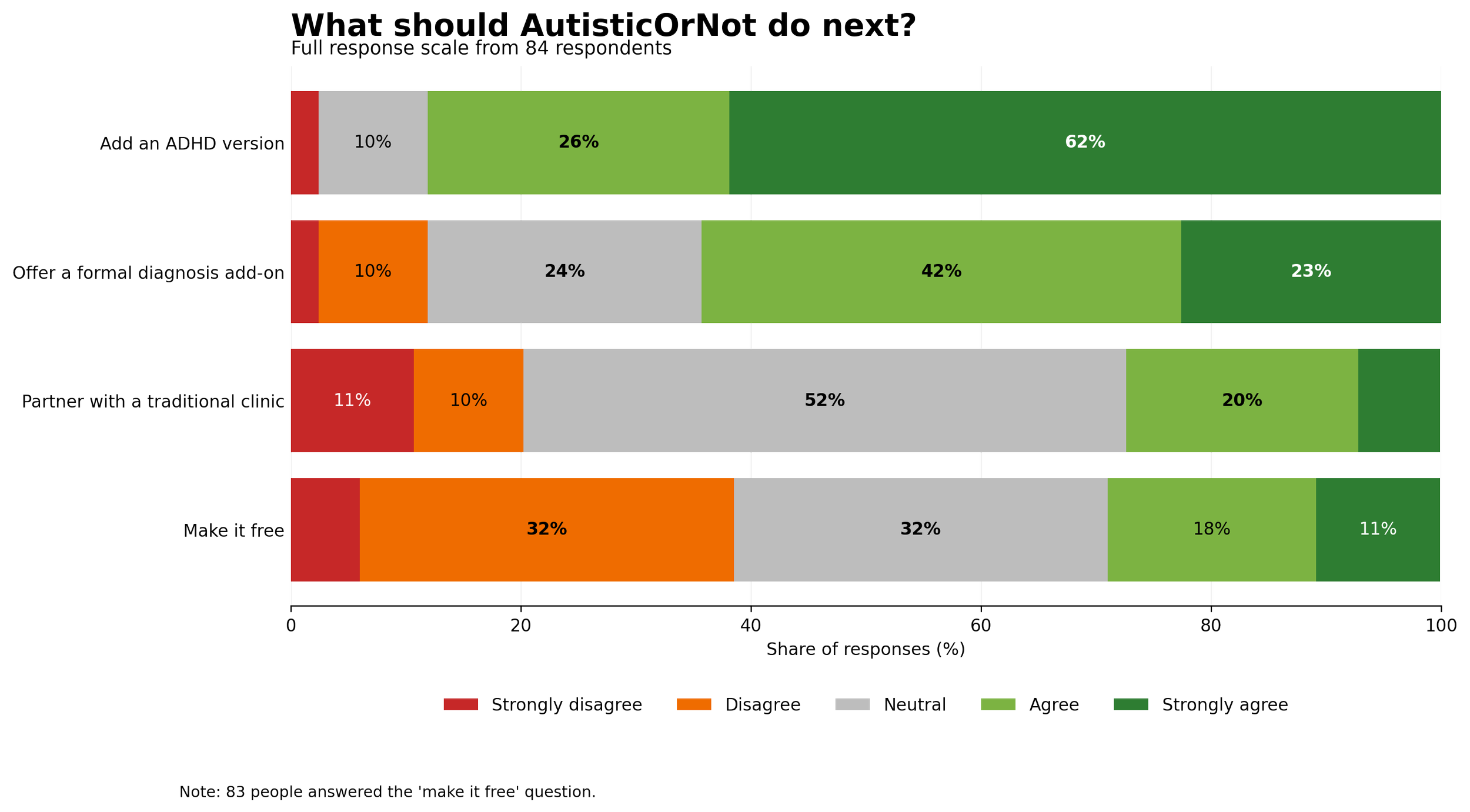
Last week, we asked everyone who has completed AutisticOrNot what they thought we should do next. 84 people responded, and 31 of them also left written feedback, sharing their ideas, concerns and experiences in more detail.
The clearest result was on the question of if we should release our ADHD “version”. 88% agreed or strongly agreed that we should create and launch an ADHD version, and several comments went further, asking specifically about AuDHD and how autism and ADHD can interact.
There was also substantial interest in somewhere to go after the current assessment. 64% supported offering a route towards formal diagnosis, although the written responses suggest people want more than simply another test. They talked about deeper exploration, someone to discuss their results with, neurodivergent-informed support, and a recognised diagnosis where that is important to them and where it is not. Many were happy with their report as the only step they desired. The concept of peer support was particularly interesting (participants supporting each other rather than entering into paid therapy).
The response to partnering with a traditional clinic was much more cautious. Just 27% agreed or strongly agreed, while 52% were neutral. Some people could see benefits, particularly access to “gold level” recognised diagnosis and insurance paid options, but there was repeated concern about protecting the independence, accessibility and approach that made AutisticOrNot useful to them in the first place. Some felt clinics are currently overly commercialised whereas our approach removed that pressure.
There was no similar demand to make the assessment free. 29% supported this, 39% disagreed or strongly disagreed, and 33% were neutral. The comments around price were particularly useful because many people were thinking about sustainability as well as accessibility. We were surprised but grateful.
What came through most strongly was that people do want more from us. But they do not necessarily want AutisticOrNot to become something completely different in order to provide it. And that the “traditional route” of clinics, costs and waiting are not desired by the majority.
The most clear comments are shared below, with no negative comments withheld.
ADHD, AuDHD and what comes next
“As someone whose GP has advised has likely got both Autism and ADHD, I would really appreciate an ADHD version, especially if it explores how Autism and ADHD interact.”
“Testing for ADHD would be great as many have both.”
“I’m going to PLEAD for an ADHD version.”
“My report helped me on my way to seeking a formal diagnosis, which was autism with inattentive ADHD. Thank you.”
“I would love to be able to know if I have ADHD without a formal diagnosis.”
There was also interest in what happens after someone receives their report, particularly where the result raises new questions rather than closing them.
“After I received my report, it brought me so much clarity. I would love a formal diagnosis off the back of it.”
“My report was incredibly helpful. I would have really liked the option to get a formal diagnosis after being dismissed by the NHS.”
“A route to formal diagnosis that will be recognised by NHS would be the best possible outcome for me!”
“I would want a rather specific offering of therapy or counselling as my next steps... I need neurodivergent-informed therapy.”
“I am 69 years old and have only been trying to work things out since Covid... I would like somewhere to speak to other older undiagnosed people to compare experiences.”
Fees and accessibility
The comments here surprised us a little. Several people specifically did not want us to make the existing assessment free, because they felt the current price was accessible and understood that the project needs to support itself. This is kind of you all, as the project is still run entirely by the founder and friends.
“I also disagreed with going free because I think what you do is already so cost effective and you need to be sustainable.”
“Your assessment is already highly accessible and an excellent price point.”
“You shouldn't have to make everything free!”
“Free would be nice but also you should be compensated for your services. At the same time it should be accessible and not overly priced so some people are locked out.”
“Please keep it affordable.”
One respondent described the gap particularly well:
“I feel like there needs to be something in between a £30 overview and a £2k gold standard diagnosis... You’ve absolutely created something valuable here and it’s been very useful to me.”
Negative and critical feedback
Not everything was positive, and this matters too. One respondent felt parts of the assessment did not accurately reflect their experience:
“I felt that some parts, the childhood portion especially, unfairly counted my answers. That and the masking section did not have an analysis that matched up with my experience.”
There was also concern about adopting conventional diagnostic methods without questioning whether they work well for the people using AutisticOrNot: We agree that the methods used in some clinics are outdated and we agree that it would be irresponsible to “slip back” into that route.
“Traditional clinics use ADOS 2 for diagnosis. It is outdated and totally unsuitable for high masking, older women like myself.”
Others were less opposed to partnerships themselves, but worried about what might be lost:
“Partnering with a clinic probably has plenty of positives, but concerned this may be the start of becoming a less accessible tool.”
“A concern about partnering with a clinic would be that you could lose autonomy and agency.”
That feedback is particularly useful. There are already areas of the assessment we want to revisit and improve, and feedback like this helps us understand where people's lived experience and our interpretation do not always meet. No additional “negative” comments were shared at this time.
Thank you
Thank you to everyone who took the time to answer, and especially the 31 people who wrote something more. Some responses were encouraging, some challenged us, and quite a few raised possibilities we had not fully considered.
We are reading all of it. We will report back on social media as we work through what is realistic, what needs more investigation, and what AutisticOrNot should do next.
Alex Sass
hello@autisticornot.com